"WHEN ARAB MEETS INDIAN: TALES FROM THE ANCIENT SEA ROUTES"
BY-SANJIV KRISHNAN A
The relationship between Arab and India is one of the oldest bonds and most fascinating stories of global connections. The Arab has a timeless connection with India through travel, trade and exchange of ideas. Long before the arrival or rise of modern transportations arab traders sailed through the Arabian sea, building strong economic, religious and cultural bonds. The journeys not only depended on trade and exchange of goods but also sharing ideas about religion and culture. The early connections laid down the foundation for centuries of friendship and cultural harmony between arab and india.
kerala stood out As the main character of Arab trade because of its vast source of its spices, jewels and forest products. It's helpful for creating a better future. Trade between Arab and india began long before islam. As early as the third millennium bce, Arab merchants from the coasts of yemen and oman sailed across the arabian sea to trade with kerala and some other states of india likely with ports on malabar and konkan coasts.the monsoon winds helps them to or blow them to steadily between arab and India, made it easy to sail and convenient. Muziris and nelcynda(kerala coasts): it is an important port in India where ships from Arabian and red sea coasts were anchored.
One of the written proofs was the periplus of the erythronean sea written by an Egyptian Greek merchant describing sea routes connecting Egypt, arab and India. The periplus described that ships left from red sea ports and arab (followed in later centuries ) in july and august, when the monsoon winds blew eastwards which made them reach Indian ports in forty days. After trading and loading the goods bought from India , they returned to the homeland with the help of westward during the northeast monsoon in December and January. The predictable wind pattern made long distance trade not only possible but also forming the base for the early connection between arab and india.
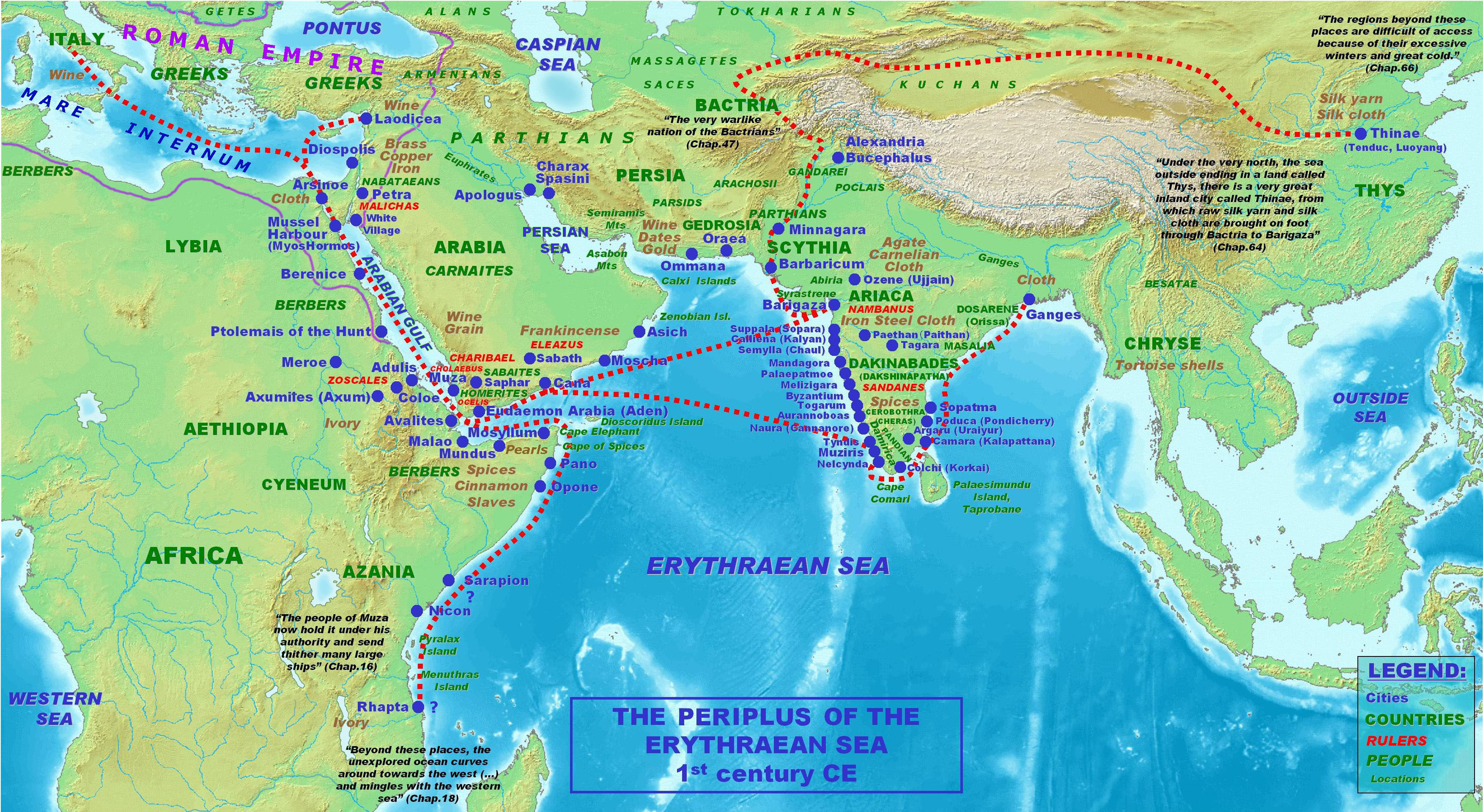
https://en.wikipedia.org/wiki/Periplus_of_the_Erythraean_Sea
Arabs came to India to bring spices, pearls, ovaries and precious stones from Kerala. They bought horses, pearls and dates into India. Ancient records and king Solomon mention the ships from india bringing timber, spices, ovary from kerala into india. Arab called India as bilad al-hind.kerala was known as malabar and land of pepper.Indian pepper is so valuable in arab and called as black gold.the red sea ports of aden, qana and mazabecame arb trading hubs for india.
Some Arab traders settled in India for convenient trade. arab traders need to stay in india for months to wait for northeast monsoon to return to their homeland, so some of the traders decided to settle in in india. Arab traders introduced islam to India through coastal areas as early as the 7th century in Kerala, Tamilnadu and Gujarat. Trade created friendly allies and mutual trust. Muhammad ibn qasim conquest( 711 ce) of sindh established the british government in india. islam is spread peacefully through trade, trust and friendship rather than war. Cheraman juma mosque in kerala reflects a combination of indian and arab architecture. Kerala's chera kingdom welcomed them for trade and they settled at kodungallur, kollam and calicut.
They intermarried with women in India and formed a community called mapilla. They blended malayali culture with arab-islamic traditions. Mappila community became a symbol of Kerala's multicultural identity. Roden e miller note that mapilla muslims “adopted islamic faith and arab traditions while preserving their malayalam language and local customs, forming a distinct cultural identity in kerala”,(miller,1976:214)

https://upload.wikimedia.org/wikipedia/commons/a/a5/Map_of_the_Periplus_of_the_Erythraean_Sea.jpghttps://upload.wikimedia.org/wikipedia/commons/a/a5/Map_of_the_Periplus_of_the_Erythraean_Sea.jpghttps://upload.wikimedia.org/wikipedia/commons/a/a5/Map_of_the_Periplus_of_the_Erythraean_Sea.jpg
The famous story of cheraman perumal, the chera kingwent to arabia where he met prophet and embraced islam and changed is name top tajuddin.according to tufat al-mujaidin by sheik zeinuddin(16th century), malik ibn dinar arrived in kerala with fellow preachers and built first mosque in india at kodungallur.
The Mappila community and arab also influence the Indian language. Many of the arab words entered into indian language and it also it in day to day life. The language in the west coast is deeply affected by arab. Words like safar (journey), dukan (shop) , maal (goods) and hissab ( accounts) have arab origin. The mapila was developed into arab malayalam, where the malayalam language is transcripted using arabic script. Many songs , poems, stories are created through this. The mappila community became a living bridge between Arab and Indian civilisation, symbolizing centuries of cultural co-operation and co-existence.
The legacy of the Arab-Indian connection travels for a thousand years. Even after the arrival of portegeuse in the 15th century, Arab trade links continued in smaller forms. European powers might have dominated spice travel , but the cultural and social influence of Arabs stays deeply rooted in India.
Arabs bought knowledge like astronomy, mathematics, medicine and education.
ASTRONOMY: knowledge of stars and navigation techniques helped Indian sailors.
MATHEMATICS: introduction to arabic numerals and algebra influenced by indian
MEDICINE: Unani medicine( arabic medicinal systems) established in india.
EDUCATION: Madrasas(islamic schools) prompted learning in arabic, theology and science
Biriyani and kebab have originally persian-arabic influence via traders and influence and much more knowledge.
CONCLUSION: the early connection between arab and india was more than trade , it also exchange of dynamic ideas of culture, religion and knowledge. Arabs not only brought spices, timber, ivory, and precious stones and shared knowledge about astronomy, mathematics, medicine, architecture, education and religious practices, leaving a long lasting imprint on Indian society. From new navigation techniques, architectural techniques and culinary delights can be still felt today.especially in kerala, they built trust and friendship over centuries. The mapilla community is the living example of cultural blending. The early connections show how trade created long lasting bonds and left a mark that can be still today. Kerala remains a key place where arab and indian history meet, showing the long lasting impact on their early relationship.
CITATIONS AND REFERENCES
1.Babu, F. M. (2021). Early Arab trade with India: With special reference to Kerala. International Journal of History, 3(2), 01–04. https://doi.org/10.22271/27069109.2021.v3.i2a.91
2.Ahmad, S. (n.d.). India and the Arab World: Fusion of art, culture and traditions. Maulana Azad National Urdu University. Retrieved from https://manuu.edu.in/sites/default/files/Research-Publication/Islamic-Studies/Shakeel-Ahmad/Journals/India%20and%20the%20Arab%20World%20-Fusion%20of%20Art%20%2CCultureand%20Traditions-%20journals.pdf
3.Chembirika Ebrahim, A. I. (2021). The Mappila community and their culture in the southern part of India, Kerala. APJIR: An International Journal of Humanities and Social Science, 5(3), 554–560. Retrieved from https://dergipark.org.tr/en/download/article-file/2121871
4.Gholami Dehghi, A. (n.d.). The historical signs of the peaceful advent of Islam to Indian subcontinent (From the beginning to the Ghaznavid dynasty). Retrieved from https://www.ijss-sn.com/uploads/2/0/1/5/20153321/18_ijss_iran_isi_july_oa18_-_2017.pdf
5.Khatri, J. (2016). The influence of Arabic on Indian language: Historically and linguistically. International Journal of Management and Applied Science, 2(11, Special Issue-1). Retrieved from https://www.iraj.in/journal/journal_file/journal_pdf/14-319-1482401254159-163.pdf
6.[Author unknown]. (n.d.). The Periplus of the Erythraean Sea. Retrieved from https://dn790003.ca.archive.org/0/items/cu31924030139236/cu31924030139236.pdf


Comments
Post a Comment